 How my food lives
Product
Fish: welfare and labels compared
Natural lifespan: Plaice up to 50 years, sole 26, herring 25 (highest known ages). In practice: no figure found for the age at catch. Wild-caught and farmed. The questions apply to fish as well; how we read them is explained below.
Eight questions, eight answers
- How old are fish when they are killed for food?
Could live decades. We found no figure on the age at catch. - Do farmed fish ever see their parents?
Usual for farmed fish: young from a hatchery. - How much space do farmed fish have?
Usual: farmed salmon without a label comes from Norway, where the law allows at most 25 kilograms per cubic metre. - What does a farmed fish's habitat look like?
No rule on a resting place for farmed fish. - Do farmed fish live outdoors?
Usual: farmed salmon grows up in tanks and then lives in open sea pens in Norway. - What treatments do farmed fish get?
The farmed salmon sold here comes from Norway, where the law bans operations on live fish except by a vet or fish health biologist. - How long are live fish transported?
No figure on journeys of farmed fish was found. - How are fish killed?
Wild fish mostly die in the net, and EU law sets no stunning duty for fish. Dutch law asks it only for eel.
Labels and standards at a glance
Level 1 is the lowest, the top level of the question is the best. A range such as 2-3 means our sources do not settle on one level. ? = no fixed rule.
Prices
| Standard | typical | range | What was priced |
|---|---|---|---|
| Wild fish with MSC | €11.09 per kg | frozen wild salmon fillet, MSC, n=1, as of 22 Nov 2026 PLUS (wild salmon fillet 540 g) | |
| Farmed salmon without label (legal minimum, farmed in Norway) | €24.78 per kg | farmed salmon fillet, farmed in Norway, no ASC named on the product page; scored by Norwegian law, n=1, as of 22 Nov 2026 PLUS (salmon fillet with skin 500 g) |
Videos
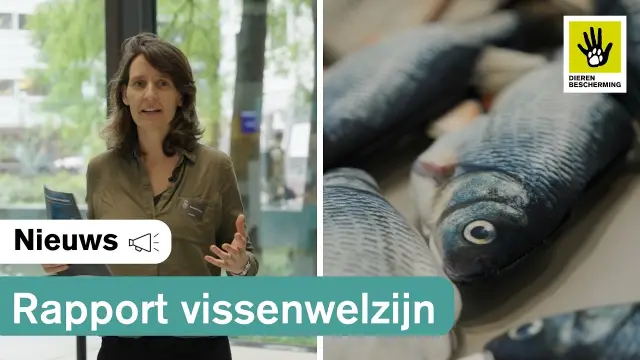 Towards animal-worthy fisheries and aquacultureDierenbescherming, 3 min
Presents a report on fishing and fish farming by the Dierenbescherming, CIWF Netherlands and the Dierencoalitie. From an advocacy group.
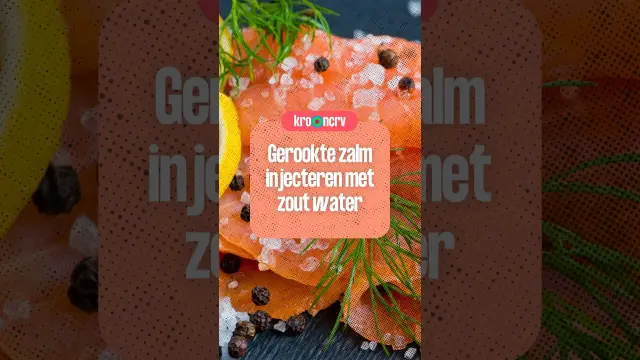 They inject liquid into the salmon?!Keuringsdienst van Waarde (KRO-NCRV), 60 s
Short item on smoked salmon and how makers add liquid. It covers the product, not the farming.
Note: this video shows images some people find distressing.
Salmon Suffering In Scottish Fish FarmsCompassion in World Farming, 3 minFootage from Scottish salmon farms, not Dutch ones. English only; fills the fish gap. From an advocacy group.
Sources
- Wild catch: the fish lives free until caught (our own reading)
- Mood and Brooke 2024, global numbers of wild-caught fish
- Fishcount estimates (no welfare rule for killing wild-caught fish)
- MSC Fisheries Standard v3.0 (no welfare rule for capture or killing)
- Akvakulturdriftsforskriften (FOR-2008-06-17-822), Norwegian aquaculture regulation, paras 25, 31 and 34, as read for our Norway table
- PLUS, product page Zalmfilet met huid 500 g: no ASC, origin Norway, farmed in the fjords of Norway
- Forskrift om næringsmessig transport av dyr (FOR-2012-02-08-139), Norwegian animal transport regulation, as read for our Norway table
- Dyrevelferdsloven (LOV-2009-06-19-97), Norwegian animal welfare act, as read for our Norway table
- PLUS, product page Vis Marine zalmfilets: ASC logo, salmon farmed in Norway in open aquaculture
- ASC Farm Standard V1.0.1A2 (August 2026), indicators 4.1.1.12, 4.1.3.2 to 4.1.3.6
- Regulation (EU) 2018/848, Annex II Part II (livestock), original text
- Implementing Regulation (EU) 2020/464, Articles 2, 9, 22 and Annexes I and II
- Regulation (EC) No 1/2005, Annex I Chapter V points 1.2, 1.4, 2.1
- FishBase: plaice (Pleuronectes platessa), maximum reported age
- FishBase: common sole (Solea solea), maximum reported age
- FishBase: Atlantic herring (Clupea harengus), maximum reported age
- CBS StatLine table 83622NED: Visserij en aquacultuur, hoeveelheid vis, schaal- en schelpdieren (annual 2024, final)
- Wet dieren art. 2.8 (physical interventions banned unless veterinary necessity or designated) with Besluit diergeneeskundigen art. 2.2 (poultry; beak treatment was phased out from 1 September 2018 and is now only possible under the temporary exemption in Regeling diergeneeskundigen art. 7.3, which ended for laying hens on 1 January 2019, see stcrt), 2.3 (pigs: castration, tail docking up to 4 days, teeth filing up to 7 days, the last two only after injuries are seen and other measures failed), 2.4 (cattle: dehorning, nose ring for breeding bulls), 2.7 (no unnecessary pain)
- Regulation (EC) No 1099/2009, Article 4(1) and 4(4) (stunning duty for mammals and birds); Article 1(1): for fish only Article 3(1) applies (spare avoidable pain, distress or suffering), so EU law has no stunning duty for fish
- Besluit houders van dieren (Wettenbank BWBR0035217), articles 1.6, 1.11, 1.20, 2.2 to 2.5, 2.12, 2.17, 2.28, 2.30-2.46, 2.50, 2.71, 5.1, 5.10 and 5.11
- Good Fish Foundation, method of the VISwijzer (sustainability only)