 How my food lives
Product
Fish: welfare and labels compared
Natural lifespan: Carp: up to 38 years (highest known age). In practice: Pond carp: 3 summers. Wild-caught and farmed, here mostly trout, char and carp from Austrian ponds. The questions apply to fish as well. How we read them is explained below.
Eight questions, eight answers
- How old are fish when they are killed for food?
Slaughtered as soon as the fish reaches eating size. - Do farmed fish ever see their parents?
Usual is that the young fish never see their parents. - How much space do farmed fish have?
BIO AUSTRIA allows at most 10 kilograms of trout per cubic metre of pond volume. - What does a farmed fish's habitat look like?
BIO AUSTRIA requires near-natural ponds with natural soil. - Do farmed fish live outdoors?
Usual is the hatchery indoors, later the net pen at sea. - What treatments do farmed fish get?
Usual are treatments against parasites and diseases. - How long are live fish transported?
Usual are trips of live fish without a fixed hour limit. - How are fish killed?
Wild fish mostly die in the net, in the air or on ice.
Labels and standards at a glance
| Standard | Lifespan | Mother and young | Freedom of movement | Resting place | Outdoors | Physical interventions | The final journey | Death |
|---|---|---|---|---|---|---|---|---|
| AMA-Gütesiegel fish (Austria) | ? | ? | ? | ? | ? | ? | ? | 2 |
| BIO AUSTRIA carp (pond) | ? | ? | 4 | 3 | 4 | 2 | ? | 2 |
| BIO AUSTRIA trout (pond, flow channel) | ? | ? | 3 | 3 | 3-4 | 2 | ? | 2 |
| Organic (EU) aquaculture (salmon, trout) | 1-2 | 1 | 2-3 | 1-3 | 3-4 | 2-3 | 1 | 2-3 |
| Wild fish with the MSC label | 1-4 | 4 | 4 | 4 | 4 | 4 | 4 | 1 |
| Salmon with the ASC label | 1-2 | 1 | 1 | 1 | 3-4 | 2 | 1 | 2-3 |
| Naturland aquaculture | 1-2 | 1-2 | 3 | 1-3 | 3-4 | 2-3 | 1 | 2-3 |
Level 1 is the lowest, the top level of the question is the best. A range such as 2-3 means our sources do not settle on one level. ? = no fixed rule.
Prices
| Standard | typical | range | What was priced |
|---|---|---|---|
| Organic (EU) aquaculture (salmon, trout) | €33.45 per kg | €26.95 to €39.95 | organic salmon fillet, n=2, as of 21.11.2026 BILLA, HOFER |
Videos
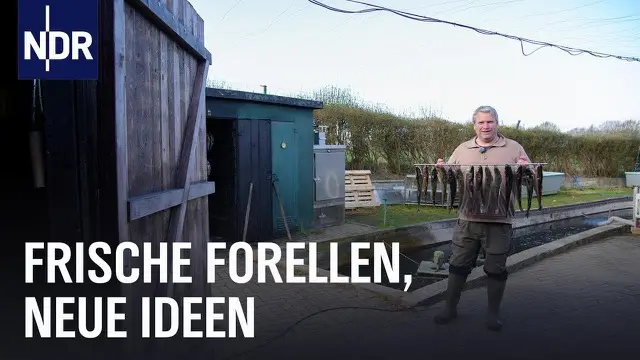 Trout farming: between pond, smokehouse and marketNDR Doku, 29 min
A farmer runs a trout farm with ponds in Lower Saxony. The film shows daily work at the pond.
Sources
- AMA-Gütesiegel guideline for fish and fish products, version 2015/1
- BIO AUSTRIA production guidelines, November 2025
- Rung copied from the German table (there based on EU law, a label text or biology, partly without a source of its own; not re-checked for Austria)
- Norway: Akvakulturdriftsforskriften (FOR-2008-06-17-822), Norwegian aquaculture regulation, as read for our Norway table (no hour limit for transporting live fish)
- Norway: Forskrift om næringsmessig transport av dyr (FOR-2012-02-08-139), Norwegian animal transport regulation, as read for our Norway table
- Wild catch: the fish lives free in the sea, a lake or a river until it is caught
- Wild catch: the fish lives free until it is caught; it may be caught young or old, and no rule sets an age (biology, no rule)
- ASC Salmon Standard v1.4 (September 2022), as read for our Norway table: no hour limit for transport; the origin of the ASC salmon sold in Austria is not sourced, and its law was not checked
- FishBase: common carp (Cyprinus carpio), maximum reported age
- FishBase: Atlantic salmon, maximum reported age
- FishBase: rainbow trout, maximum reported age
- MSC standard (no rule on killing the fish)
- EFSA 2009: killing of rainbow trout (opinion)