 How my food lives
Dairy · Mother and young
Are calves separated from their mothers?
Usual: the calf is taken away within hours. Furthest along: Regenerative Organic Certified dairy, Gold. Weakest: 7 standards, among them Legal minimum (federal; no federal dairy welfare law) and USDA Organic milk (7 CFR 205).
Why it is like this
In 2014 about one in four US dairy calves was separated from the cow in under an hour, and most farms did it within 12 hours (USDA NAHMS). Only Regenerative Organic Gold keeps heifer calves with a cow until weaning; AWA only recommends it. Male calves are mostly sold within days; bob veal calves are slaughtered under 3 weeks old at about 150 pounds. A cow gives milk only after she has calved.
What the labels say
| Standard | Level |
|---|---|
| Legal minimum (federal; no federal dairy welfare law) | 1 Only briefly. It may be separated right after birth |
| USDA Organic milk (7 CFR 205) | 1 Only briefly. It may be separated right after birth |
| Certified Humane dairy | 1 Only briefly. It may be separated right after birth |
| Animal Welfare Approved dairy | 1 Only briefly. It may be separated right after birth |
| American Humane Certified dairy | 1 Only briefly. It may be separated right after birth |
| Regenerative Organic Certified dairy, Bronze | 1 Only briefly. It may be separated right after birth |
| Regenerative Organic Certified dairy, Silver | 1 Only briefly. It may be separated right after birth |
| Regenerative Organic Certified dairy, Gold | 2 A few weeks |
How we read the levels
- Only briefly. It may be separated right after birth.
- A few weeks.
- Several months.
- Until the two part of their own accord.
Level 1: Only briefly. It may be separated right after birth.
Applies to: Legal minimum (federal; no federal dairy welfare law), USDA Organic milk (7 CFR 205), Certified Humane dairy, Animal Welfare Approved dairy, American Humane Certified dairy, Regenerative Organic Certified dairy, Bronze and Regenerative Organic Certified dairy, Silver
The calf is taken from its mother soon after birth. In 2014 about one in four US dairy calves was separated within the first hour, and most farms did it within 12 hours.
USDA's Dairy 2014 study (17 states, 80.5 percent of operations): 10.6 percent of operations, holding 26.0 percent of calves, separated calves from the cow in under 1 hour, and the majority of operations did so in under 12 hours. Heifer calves were weaned at 9.0 weeks on average. USDA Organic lets newborn dairy calves be kept off pasture for up to six months and in individual pens until weaned (205.239(a)(7), (c)(2)). Certified Humane has no rule on contact with the cow that we found, and allows individual stalls up to 8 weeks. AWA only recommends rearing by the mother (4.4.6, 4.6.1); after separation, mother and calf must be in adjacent pens or out of sight and hearing (4.6.6). Regenerative Organic Gold is the one exception (see level 2). Male calves: surplus calves are typically sold within days of birth, bob veal at under 3 weeks and 150 pounds, and about 40 percent of male calves go through auctions (Creutzinger and others 2021). NASS counted 124,600 calves slaughtered in 2025, at an average live weight of 343 pounds. We have no figure for where the other male calves go.
Level 2: A few weeks.
Applies to: Regenerative Organic Certified dairy, Gold
Regenerative Organic Gold keeps heifer calves with their mothers until they are weaned. No weaning age is written, so we score the lower level 2.
Regenerative Organic Certified, Animal Welfare guidance v1.2, dairy module, Gold: heifer calves stay paired with the mother until fully weaned, and individual hutches are not permitted. Male calves are not covered, and as for every dairy row we score the cell by the heifers. Without a weaning age the rule could mean a few weeks, so level 2 counts (our reading).
What stays open
American Humane has no usable rule on this. The usual case is separation within hours.
Videos
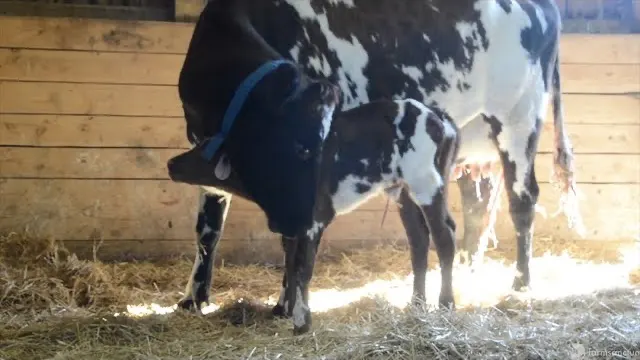 ICYMI: Dairy Milk Comes From Mother CowsFarm Sanctuary, 1 min
Farm Sanctuary explains in one minute that milk comes from cows that have calved. From an advocacy group.
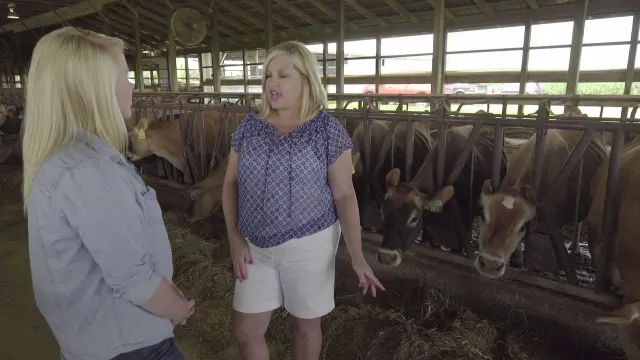 Mom to Mom: Why Separate Calves From Their Mothers?OhioDairyFarmers, 1 min
An Ohio dairy industry group gives its reasons for separating calves from their mothers. Older video. From an industry body.
Sources
- USDA APHIS NAHMS: Colostrum Feeding and Management on U.S. Dairy Operations, 1991-2014 (Information Brief, Sept 2021)
- USDA APHIS NAHMS: Trends in Dairy Cattle Health and Management Practices in the United States, 1991-2014 (Dairy 2014)
- 7 CFR 205.239 Mammalian and non-avian livestock living conditions (eCFR)
- Certified Humane (HFAC) Standards for Dairy Cattle, 2025 print
- AWA Dairy Cattle Standards 2026 v1
- Regenerative Organic Certified Framework Guidance, Animal Welfare, v1.2, 4 December 2023
- Creutzinger and others 2021, Perspectives on the Management of Surplus Dairy Calves in the United States and Canada, Frontiers in Veterinary Science 8
- USDA NASS: Livestock Slaughter 2025 Summary (April 2026)
- Animal Welfare Act definitions, 7 USC 2132(g) (Cornell LII): 'animal' means warm-blooded animals and excludes livestock and poultry used for food or fiber; no federal rule on farm housing, space, outdoor access, weaning or alterations (no rule)
- American Humane Certified Dairy Cattle Standards, revision date February 2020 on the cover (file posted February 2025)
- Everything on Dairy
- How long do dairy cows live?
- How much room do dairy cows have?
- What do dairy cows lie on?
- Do dairy cows get to graze on pasture?
- Are dairy cows' horns removed?
- How long are cows transported?
- How are dairy cows slaughtered?
- Label: Legal minimum (federal law)
- Label: USDA Organic
- Label: Certified Humane
- Label: Animal Welfare Approved (AWA)
- Label: American Humane Certified
- Label: Regenerative Organic Certified (dairy)
- Legal minimum (federal law) vs USDA Organic: Dairy
- Legal minimum (federal law) vs Certified Humane: Dairy
- Legal minimum (federal law) vs Animal Welfare Approved (AWA): Dairy
- Legal minimum (federal law) vs American Humane Certified: Dairy