 How my food lives
Dairy · Mother and young
Are calves separated from their mothers?
A calf could stay with its mother for months. On most Dutch farms it is gone within a day. Furthest along: Demeter plus module Kalfjes bij de koe (voluntary). Weakest: 8 standards, among them Legal minimum (NL/EU) and Beter Leven 1 star.
Why it is like this
A cow only gives milk after she has calved (Wageningen). In a 2016 survey of 534 Dutch dairy farmers, the calf was taken away at once or after the cow had licked it dry on 66 of 100 farms, and within a day on 91 of 100. Beter Leven allows the licking and recommends, but does not require, 3 months together at 3 stars. Only the Demeter plus module 'Kalfjes bij de koe' keeps calves with the cow for 30 days to 12 weeks. We found no national count of farms that keep calves with their cows.
What the labels say
| Standard | Level |
|---|---|
| Legal minimum (NL/EU) | 1 Taken from its mother soon after birth |
| Beter Leven 1 star | 1 Taken from its mother soon after birth |
| Beter Leven 2 stars | 1 Taken from its mother soon after birth |
| Beter Leven 3 stars | 1 Taken from its mother soon after birth |
| PlanetProof / On the way to PlanetProof | 1 Taken from its mother soon after birth |
| EU organic leaf (Skal) | 1 Taken from its mother soon after birth |
| EKO dairy (EU organic plus Aanvullende Normen Zuivel) | 1 Taken from its mother soon after birth |
| Demeter | 1 Taken from its mother soon after birth |
| Demeter plus module Kalfjes bij de koe (voluntary) | 2 A few weeks |
How we read the levels
- Taken from its mother soon after birth.
- A few weeks.
- Several months.
- Until the two part of their own accord.
Level 1: Taken from its mother soon after birth.
Applies to: Legal minimum (NL/EU), Beter Leven 1 star, Beter Leven 2 stars, Beter Leven 3 stars, PlanetProof / On the way to PlanetProof, EU organic leaf (Skal), EKO dairy (EU organic plus Aanvullende Normen Zuivel) and Demeter
In Dutch dairy farming the calf is taken from the cow soon after birth. The law, Beter Leven (1 to 3 stars), organic, EKO and Demeter do not guarantee more. PlanetProof has no rule on cow and calf either.
In a 2016 survey of 534 Dutch dairy farmers (Van Hall Larenstein, 13 April 2016), the calf was taken from the cow at once after birth on 16 percent of farms, after the cow had licked it dry on 50 percent, within one day on 25 percent and within two days on 6 percent. Beter Leven allows the cow to lick the calf dry before separation (HK01). At 3 stars, staying together for 3 months is only a recommendation (HK01a). EU organic prefers maternal milk for 90 days, which is not contact with the cow (2020/464 art. 2). Demeter gives milk for at least three months, not necessarily from the mother (6.3.6.5). Dutch law has no rule on contact between cow and calf (Besluit houders van dieren), so the law sits here.
Level 2: A few weeks.
Applies to: Demeter plus module Kalfjes bij de koe (voluntary)
Only the Demeter plus module 'Kalfjes bij de koe' (calves with the cow) keeps calves with the cow, heifer calves at least 12 weeks, bull calves at least 30 days.
Demeter Plusnormen, module 'Kalfjes bij de koe', norms 2.2 and 2.3. The bull calves do not decide the cell of the cow. Her heifer calves stay 12 weeks, which is under 3 months, so the standard is at rung 2. The module is voluntary and an add-on to Demeter; farms in it may put the claim 'kalf bij de koe' on their products.
What stays open
PlanetProof (criteria M.3.0) sets no rule on cow and calf, so it takes the legal level 1.
Videos
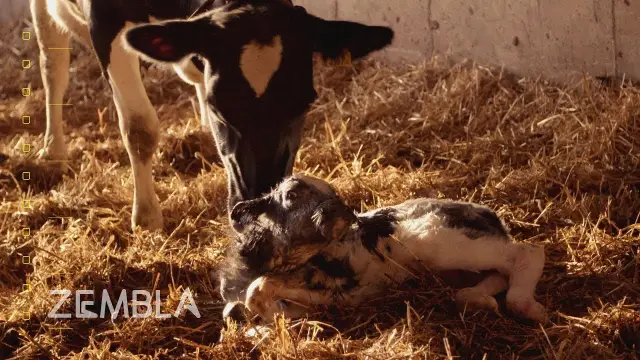 How sustainable is veal farming?Zembla (BNNVARA), 35 min
Zembla investigates the Dutch veal chain and the import of calves from abroad.
Note: this video shows images some people find distressing.
Abuses in calf transports exposedZembla (BNNVARA), 11 minFootage of calves on transport from Ireland to the Netherlands, filmed by animal welfare groups.
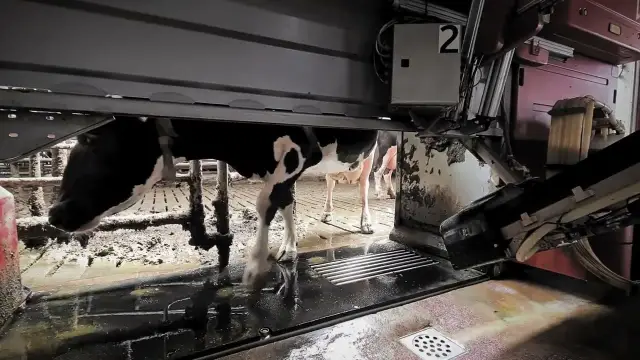 Her story: the life of a dairy cow in one minuteWakker Dier, 61 s
Short film by Wakker Dier on pregnancy, calf and milk production. From an advocacy group.
Sources
- Beter Leven Melkrund 1 ster v2.1, 2 sterren v1.1, 3 sterren v2.1 (ZW, 2025-02-03)
- Beter Leven, page on dairy cows
- Implementing Regulation (EU) 2020/464, Articles 2, 9, 22 and Annexes I and II
- International Demeter Biodynamic Standard (as of September 2025), sections 6.3.5.1, 6.3.5.3, 6.3.5.4, 6.3.6.5, 6.3.10, Appendix 7
- Van Hall Larenstein (Hopster, Bergsma, Biewenga) for De Duurzame Zuivelketen, 13 April 2016, survey of 534 Dutch dairy farmers
- Besluit houders van dieren (Wettenbank BWBR0035217), articles 1.6, 1.11, 1.20, 2.2 to 2.5, 2.12, 2.17, 2.28, 2.30-2.46, 2.50, 2.71, 5.1, 5.10 and 5.11
- On the way to PlanetProof Melk, criteria M.3.0 (SMK, in force from 1 January 2025, update of June 2026 with decisions up to 18 June 2026), criteria 4.1, 4.9, 4.11, 4.13, 4.14, 4.17.1 and annex 2 (sector agreements)
- Demeter Plusnormen Module Kalfjes bij de koe, norms 2.2 and 2.3
- Wageningen Livestock Research, Rapport 1134, Feiten en cijfers over de Nederlandse veehouderijsectoren 2018 (Van der Peet and others), sections on dairy cows, pigs and beef bulls
- Everything on Dairy
- How long do dairy cows live?
- How much room do dairy cows have?
- What do dairy cows lie on?
- Do dairy cows get to graze on pasture?
- Are dairy cows' horns removed?
- How long are cows transported?
- How are dairy cows slaughtered?
- Label: Legal minimum (law)
- Label: Beter Leven (Dierenbescherming)
- Label: PlanetProof / On the way to PlanetProof
- Label: EU organic (Skal)
- Label: EKO
- Label: Demeter
- Legal minimum (law) vs Beter Leven (Dierenbescherming): Dairy
- Legal minimum (law) vs EU organic (Skal): Dairy
- Legal minimum (law) vs EKO: Dairy
- Legal minimum (law) vs Demeter: Dairy