 How my food lives
Beef · Mother and young
How long do calves stay with their mother?
Usual: dairy-origin calves leave the farm of birth after four weeks at the earliest under 1 star. Level at the front: Beter Leven 2 stars and Beter Leven 3 stars. Weakest: 9 standards, among them Legal minimum (NL/EU) and Beter Leven 1 star.
Why it is like this
Suckler calves stay with the cow 3 months at Beter Leven 1 star, 5 months at 2 stars and 6 months at 3 stars. Calves from dairy farms follow an exception at 1 star: they may leave after 28 days once the cow has licked them clean. EU organic prefers maternal milk for 90 days but does not require the calf to stay with the cow. So 1 star counts at the lowest rung. Veal: Calves go to veal farms from 14 days of age in common practice; Beter Leven allows it from 28 days at 1 and 2 stars and from 3 months at 3 stars. EU law bans transport over 100 km below 10 days. A calf that is slaughtered at six to ten months cannot stay with its mother until they part. The Dierenbescherming writes that about 800,000 of the 1.4 million calves kept for veal each year are imported.
What the labels say
| Standard | Level |
|---|---|
| Legal minimum (NL/EU) | 1 Only briefly. It may be separated right after birth |
| Beter Leven 1 star | 1-3 level 1 guaranteed (Only briefly. It may be separated right after birth); up to level 3 depending on the farm |
| Beter Leven 2 stars | 3 Several months |
| Beter Leven 3 stars | 3 Several months |
| EU organic leaf (Skal) | 1 Only briefly. It may be separated right after birth |
| EKO (Stichting EKO-keurmerk) | 1 Only briefly. It may be separated right after birth |
| Demeter | 1 Only briefly. It may be separated right after birth |
| Veal: legal minimum for calves (NL/EU) | 1 Only briefly. It may be separated right after birth |
| Veal: Beter Leven 1 star (calves) | 1 Only briefly. It may be separated right after birth |
| Veal: Beter Leven 2 stars (calves) | 1 Only briefly. It may be separated right after birth |
| Veal: Beter Leven 3 stars (calves) | 1 Only briefly. It may be separated right after birth |
How we read the levels
- Only briefly. It may be separated right after birth.
- A few weeks.
- Several months.
- Until the two part of their own accord.
Level 1: Only briefly. It may be separated right after birth.
Applies to: Legal minimum (NL/EU), Beter Leven 1 star, EU organic leaf (Skal), EKO (Stichting EKO-keurmerk), Demeter, Veal: legal minimum for calves (NL/EU), Veal: Beter Leven 1 star (calves), Veal: Beter Leven 2 stars (calves) and Veal: Beter Leven 3 stars (calves)
The calf is separated from its mother within hours or days. Dutch law has no rule against it, and this is usual for calves from dairy herds, including organic ones: EU organic prefers maternal milk for 90 days but does not require the calf to stay with the cow. Veal: the calf is taken from its mother right after birth or within days, and leaves the dairy farm young. In practice calves go to veal farms from 14 days of age; Beter Leven allows it from 28 days (1 and 2 stars) and from 3 months (3 stars). All veal standards sit here.
Regulation 2020/464 Article 2 gives 90 days for bovine animals as the period of feeding preferably with maternal milk. Demeter's plus module "Kalfjes bij de koe" is a separate voluntary add-on (not counted here). Beter Leven 1 star lets calves from dairy farms be taken from the cow once she has licked them clean; they must then stay 28 days on the farm of birth, which is not time with the mother (norms VB01.1 and ST02.1). That is why 1 star is scored at this rung: the exception for dairy calves sets the lower end, so the standard covers 1 to 3 and counts at 1. Veal: Regulation 1/2005 bans transport of calves under 10 days over 100 km (Annex I). The Beter Leven calf page names 14 days as usual practice. The Dierenbescherming writes that the Netherlands keeps 1.4 million calves a year for veal and that about 800,000 calves come into the country each year. Beter Leven norm T05 sets 28 days from 1 January 2023, and a 3 star norm sets 3 months. No rule requires that the calf stays with the cow, so all standards are counted at 1. The Besluit houders van dieren exempts suckled calves from its single-box and floor-area rules (art. 2.30) but does not require suckling.
Level 2: A few weeks.
Possible on some farms, not guaranteed: Beter Leven 1 star
A few weeks together. No beef standard guarantees this: Beter Leven 1 star lets dairy-origin calves stay 28 days on the farm of birth, without a rule that they stay with the cow. No veal standard reaches it either.
VB01.1 and ST02.1 in the 1 star document. The 2 and 3 star documents carry no such exception. Veal: Beter Leven 1 and 2 stars keep calves on the farm of birth for 28 days, but the norm text says nothing about the cow.
Level 3: Several months.
Applies to: Beter Leven 2 stars and Beter Leven 3 stars
Possible on some farms, not guaranteed: Beter Leven 1 star
Several months with the mother: suckler calves stay with the cow 3 months at 1 star, 5 months at 2 stars and 6 months at 3 stars. No veal reaches this rung: at 3 stars the calf may not move before 3 months, but no norm keeps it with its mother.
Norms VB01.1 to VB01.3. The Beter Leven beef page gives the same three periods. Only suckler herds qualify. Beter Leven 1 star reaches this rung only for suckler calves; calves from dairy farms may leave the cow once licked clean, so 1 star is scored at 1. The 2 and 3 star documents have no such exception. The rule gives no sign that cow and calf live together every day of that time. Veal: At 3 stars calves may not be moved to the veal farm before 3 months of age (norm T05). The Beter Leven page says that at 3 stars calves leave the farm of birth and the mother cow only after 3 months and drink from the mother. The criteria document has no norm that keeps the calf with its mother: we searched it for moeder, zoogkoe, melkvee and geboorte. A norm that calves come from Beter Leven farms is only a recommendation. So the page's claim is not in the rules, and 3 stars stay at 1.
What stays open
No Dutch law requires contact between cow and calf, so the law sits at 1.
Videos
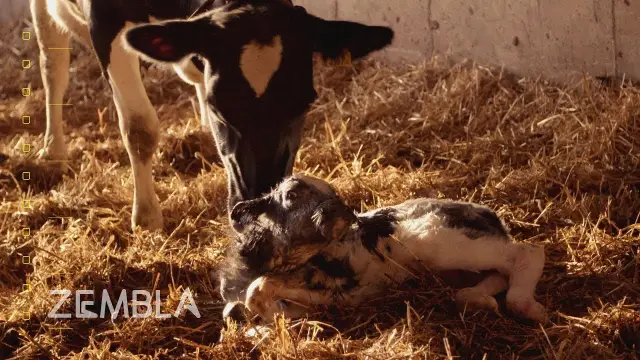 How sustainable is veal farming?Zembla (BNNVARA), 35 min
Zembla investigates the Dutch veal chain and the import of calves from abroad.
Note: this video shows images some people find distressing.
Abuses in calf transports exposedZembla (BNNVARA), 11 minFootage of calves on transport from Ireland to the Netherlands, filmed by animal welfare groups.
Further reading
Sources
- Implementing Regulation (EU) 2020/464, Articles 2, 9, 22 and Annexes I and II
- Beter Leven Runderen 1 ster v2.2, 2 sterren v2.2, 3 sterren v1.2 (ZW, 2024-09-01)
- Regulation (EC) No 1/2005, Annex I Chapter V points 1.2, 1.4, 2.1
- Beter Leven Kalveren 1 ster v2.0, 2 ster v2.0, 3 ster v1.0 (ZW, 2022-12-01)
- Beter Leven consumer page: Vleeskalveren
- Dierenbescherming, dossier calf transports
- Besluit houders van dieren (Wettenbank BWBR0035217), articles 1.6, 1.11, 1.20, 2.2 to 2.5, 2.12, 2.17, 2.28, 2.30-2.46, 2.50, 2.71, 5.1, 5.10 and 5.11
- Beter Leven consumer page: Vleesrunderen
- International Demeter Biodynamic Standard (as of September 2025), sections 6.3.5.1, 6.3.5.3, 6.3.5.4, 6.3.6.5, 6.3.10, Appendix 7
- Everything on Beef
- How long do beef bulls live?
- How much space does a fattening bull have?
- What do beef cattle lie on?
- Do beef cattle get out to pasture?
- Are cattle dehorned?
- How long are cattle transported to slaughter?
- How are cattle slaughtered?
- Label: Legal minimum (law)
- Label: Beter Leven (Dierenbescherming)
- Label: EU organic (Skal)
- Label: EKO
- Label: Demeter
- Legal minimum (law) vs Beter Leven (Dierenbescherming): Beef
- Legal minimum (law) vs EU organic (Skal): Beef
- Legal minimum (law) vs EKO: Beef
- Legal minimum (law) vs Demeter: Beef