 How my food lives
Dairy · Lifespan
How long do dairy cows live?
Could live 15 to 20 years. Leaves the farm at six and a half on average. The same for every label: The dairy cow leaves the farm at about six and a half years on average, after roughly four calvings.
Why it is like this
The dairy cow leaves the farm in Austria at 6.5 years on average, after about four calves (ZuchtData 2025), although according to associations she could live 15 to 20 years. She gives about 8,200 kilograms of milk per lactation. Her male calves are sold after a few weeks and fattened as veal calves or young bulls. In December 2025 about 536,000 dairy cows stood in Austria, 25 per farm on average (AMA).
What the labels say
How we read the levels
- Until it is big enough to be used. It may still be very young.
- Until it is at least fully grown.
- Until it has lived half of its possible life.
- Until it is old.
- Until it dies of its own accord.
Level 2: Until it is at least fully grown.
The dairy cow leaves the farm at about six and a half years on average, after roughly four calvings. That is the level of milk under the law, AMA and most programmes.
A cow could live 15 to 20 years. According to Vier Pfoten a bovine is fully grown only at five years. According to the 2025 annual report of ZuchtData (Rinderzucht Austria) the average age at exit of cows in milk recording was 6.47 years, the length of use 4.01 years and the number of calvings 4.05 (pp. 21 to 24). The report itself notes that length of use is hard to evaluate and leaves out cows sold for breeding. On average the cows gave 8,188 kg of milk per lactation in 2025 (p. 11). None of the guidelines in our table (AMA, Fair zum Tier!, Tierwohl, BIO AUSTRIA, Heumilch) says how long a cow stays on the farm.
What stays open
There is no rule on this. The usual case is that the cow leaves the farm at about six and a half years on average (ZuchtData 2025).
Videos
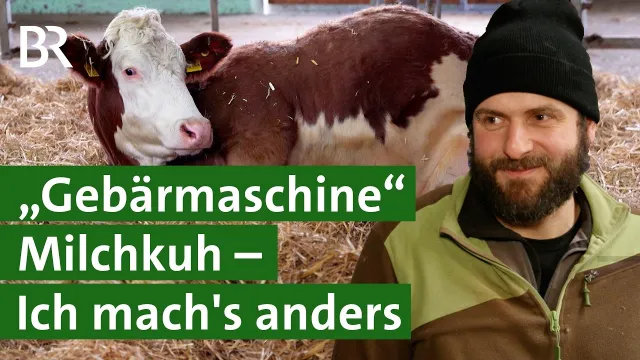 A longer calving break for dairy cowsUnser Land (BR), 6 min
An organic farmer lengthens the time between calving and insemination to ease the load on the cows. Set in Bavaria.
 Cattle welfare: keeping udder health under controlBio Austria, 7 min
An organic association item on udder health in cows. The video comes from the association itself.
 VetmedTalk: sustainability and animal welfare in farmingVetmeduni Austria, 62 min
The University of Veterinary Medicine Vienna presents projects on animal welfare and sustainability in farming. One hour of discussion.
Further reading
- ZuchtData (Rinderzucht Austria): annual report 2025, seen 21 Nov 2026 (Annual report (PDF))
- AMA-Gütesiegel guideline for keeping cows for milk and meat, version 2024 (with Tierhaltung plus) (Guideline (PDF))
- BIO AUSTRIA production guidelines, November 2025 (Guideline (PDF))
- Albert Schweitzer Stiftung: Dairy cows (in German) (Article)
- Vier Pfoten: Dairy cows (in German) (Article)
Sources
- ZuchtData (Rinderzucht Austria): annual report 2025, sections milk and fitness
- 1st Animal Husbandry Ordinance (Austria), annexes 2, 5, 6, legal database, version of 21 Nov 2026
- AMA-Marketing: dairy cows in Austria (page amainfo.at, as of December 2025)
- Swissveg: life expectancy of farm animals (animal welfare group)
- Vier Pfoten: age of farm animals (animal welfare group)
- Everything on Dairy
- Are calves separated from their mothers?
- How much room do dairy cows have?
- What do dairy cows lie on?
- Do dairy cows get to graze on pasture?
- Are dairy cows' horns removed?
- How long are cows transported?
- How are dairy cows slaughtered?
- Label: Legal minimum
- Label: AMA-Gütesiegel
- Label: Heumilch g.t.S. (hay milk)
- Label: Fair zum Tier!
- Label: Tierwohl verbessert
- Label: Tierwohl kontrolliert
- Label: BIO AUSTRIA
- Label: Demeter
- Label: Organic (EU)
- BIO AUSTRIA vs Organic (EU): Dairy
- AMA-Gütesiegel vs Organic (EU): Dairy
- Tierwohl verbessert vs Tierwohl kontrolliert: Dairy
- AMA-Gütesiegel vs Fair zum Tier!: Dairy