 How my food lives
Dairy · Outdoors
Do dairy cows get to graze on pasture?
Usual: pasture for some weeks of the summer. The same for every label: The cow goes out on some days of the year: at least 8 weeks of pasture in the summer half-year by law, 16 weeks and 6 hours a day at Dyrevernmerket, and in organic whenever weather and ground allow.
Why it is like this
The law asks for pasture for at least 8 weeks in the summer half-year. Dyrevernmerket asks for at least 16 weeks and 6 hours a day for animals over 4 months. Organic says open air whenever weather and ground allow. No text shows cows outside on almost every day of the year.
What the labels say
| Standard | Level |
|---|---|
| Legal minimum for cattle | 3 |
| Dyrevernmerket (dairy cows, milk and meat) | 3 |
| Organic (Debio, Ø-merket) | 3 |
How we read the levels
- Never. A bright barn is enough.
- Never, but it feels fresh air in the barn.
- On a few days a week.
- On almost every day.
Level 3: On a few days a week.
The cow goes out on some days of the year: at least 8 weeks of pasture in the summer half-year by law, 16 weeks and 6 hours a day at Dyrevernmerket, and in organic whenever weather and ground allow.
Cattle rules sec. 10(2): free movement and exercise on pasture for at least 8 weeks in the summer half-year. Sec. 10(3): for cattle in tie stalls 16 weeks in zones 1 to 4 and 12 weeks in zones 5 to 7; sec. 10(4): where suitable pasture is not available for barns completed before 1 January 2014, a run or other outdoor area instead. Sec. 10(5): paragraphs 2 to 4 do not apply to uncastrated males older than 6 months (this matters for beef, not for milking cows). Dyrevernmerket's dairy criteria 2.6.1: animals over 4 months at least 6 hours a day for at least 16 weeks in the summer half-year; 2.6.2(b): reducible by up to 4 weeks where natural conditions do not allow 16 weeks, with a log. Organic: Regulation 2018/848 Annex II Part II 1.7.3 and 1.9.1.1(b): permanent open-air access, preferably pasture, whenever conditions allow. The rules count weeks, not days, so rung 3.
Videos
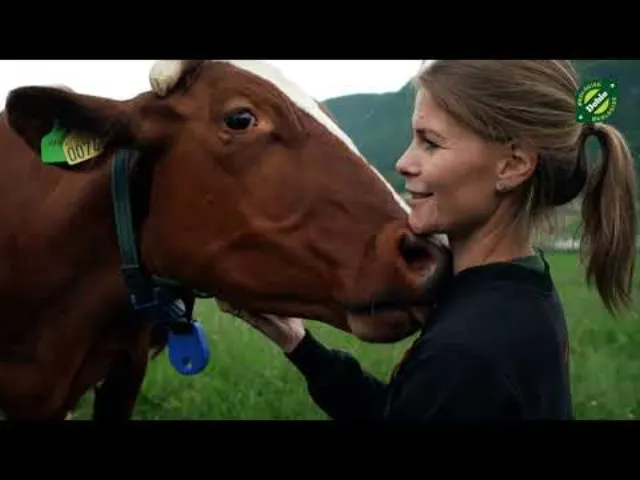 A mini-series on organic: ANIMAL WELFAREØkologisk Norge, 3 min
An organic farmer describes animal welfare for cows on her farm. From the organic farming organisation.
Further reading
Sources
- Everything on Dairy
- How long do dairy cows live?
- Are calves separated from their mothers?
- How much room do dairy cows have?
- What do dairy cows lie on?
- Are dairy cows' horns removed?
- How long are cows transported?
- How are dairy cows slaughtered?
- Label: Legal minimum
- Label: Dyrevernmerket
- Label: Organic (Debio, EU)
- Legal minimum vs Dyrevernmerket: Dairy
- Legal minimum vs Organic (Debio, EU): Dairy
- Dyrevernmerket vs Organic (Debio, EU): Dairy