 How my food lives
Eggs · Outdoors
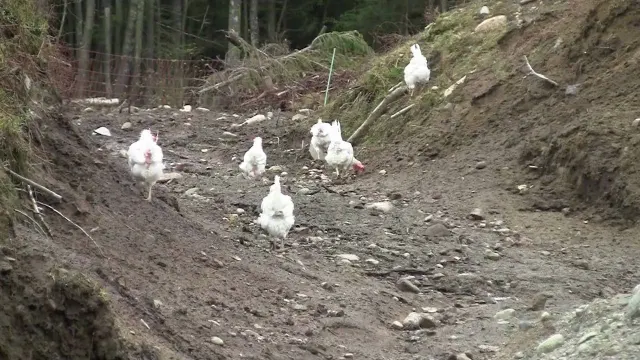
How often are laying hens outside?
Usual: no outdoor access is required. Organic gives open air for at least a third of the life. Furthest along: Organic (Debio, Ø-merket). Weakest: Legal minimum for poultry and Frittgående (cage-free barn eggs).
Why it is like this
The law does not require outdoor access for laying hens, and eggs sold as frittgående come from a barn or an aviary, not from a run. Dyrevernmerket asks for a winter garden and a run, open at least 8 hours a day, but can approve an indoor alternative to the run. Organic gives open-air access for at least one third of the life, with 4 m2 per hen. No text sends hens out on almost every day.
What the labels say
| Standard | Level |
|---|---|
| Legal minimum for poultry | 1 Never. A bright barn is enough |
| Frittgående (cage-free barn eggs) | 1 Never. A bright barn is enough |
| Dyrevernmerket (eggs) | 2-4 level 2 guaranteed (Never, but it feels fresh air in the barn); up to level 4 depending on the farm |
| Organic (Debio, Ø-merket) | 3 On a few days a week |
How we read the levels
- Never. A bright barn is enough.
- Never, but it feels fresh air in the barn.
- On a few days a week.
- On almost every day.
Level 1: Never. A bright barn is enough.
Applies to: Legal minimum for poultry and Frittgående (cage-free barn eggs)
By law a Norwegian laying hen may spend her whole life in the barn or in a cage. No outdoor access is required, and a pack marked frittgående promises a barn, not a run.
Poultry rules sec. 27 only sets the size of exit openings and the shelter of the outdoor areas where hens do have access to the outdoors. Sec. 28 bans traditional cages and sec. 29 allows furnished cages. Nortura's 2025 report says that by the end of 2025 all hens in its chain were kept in cage-free systems ('frittgående', loose housing indoors), and that all PRIOR eggs come from cage-free or organic hens (company statement); the law does not require it.
Level 2: Never, but it feels fresh air in the barn.
Applies to: Dyrevernmerket (eggs)
At Dyrevernmerket every house has a winter garden and a run, but the label can approve an indoor alternative: a roofed winter garden with walls where fresh air and daylight come in, but no open sky.
Criteria 2.8.1: the house shall be connected to a winter garden and a run, but an indoor environment with the same welfare benefits as a run can be applied for as an alternative. 2.8.2(a)-(b): access as soon as possible after placement, at least 8 hours a day after the hens have laid. 2.8.5(a),(c): the run at least 1 m2 per hen on living vegetation. 2.8.4(a),(c): the winter garden has a roof and walls and gives plenty of daylight and air. A farm with a run sits at rung 4, an approved farm without one at rung 2. An approval the label grants case by case counts as the low end, so the row reads 2 to 4 and counts at rung 2.
Level 3: On a few days a week.
Applies to: Organic (Debio, Ø-merket)
Possible on some farms, not guaranteed: Dyrevernmerket (eggs)
In organic production the hen has open-air access in the daytime, for at least a third of her life, with 4 m2 outdoors per hen. A guaranteed third of the life outdoors is rung 3.
Regulation 2018/848 Annex II Part II 1.9.4.4(d)-(e): open-air access for at least one third of the life, continuous in the daytime from as early an age as practically possible. Implementing Regulation 2020/464 Annex I Part IV point 3: at least 4 m2 of outdoor area per hen. Okologiforskriften sec. 13: the outdoor area rests at least three months after each flock. Okologiforskriften sec. 12 limits laying hens to 28 per decare (0.1 hectare) for the nitrogen limit. Guaranteed open-air access on most days for at least one third of the life is rung 3 on the scale.
Level 4: On almost every day.
Possible on some farms, not guaranteed: Dyrevernmerket (eggs)
No row guarantees this rung, but Dyrevernmerket reaches it at the upper end of its range. A Dyrevernmerket farm with a run lets hens out at least 8 hours a day, but the label can approve an indoor alternative to the run. Organic guarantees open-air access for one third of the life, which is rung 3.
Dyrevernmerket criteria 2.8.1-2.8.2; Regulation 2018/848 Annex II Part II 1.9.4.4(d)-(e).
Videos
 Choose cage-free!Dyrevernalliansen, 1 min
Explains the difference between cage, free-range and organic for hens.
 Why choose organic eggs?Debio, 2 min
Short film showing the difference between organic and conventional egg production, made with a hotel group.
Further reading
- Forskrift om hold av høns og kalkun, poultry rules (in Norwegian) (Legal text)
- Dyrevernmerket, criteria for eggs, version 1 June 2022 (in Norwegian) (Label rules)
- Regulation (EU) 2018/848 on organic production, applied in Norway (in English) (Legal text)
- Implementing Regulation (EU) 2020/464, organic rules for livestock (in English) (Legal text)
- Økologiforskriften, Norwegian organic regulation (in Norwegian) (Legal text)
- Nortura, animal welfare summary 2025 (in Norwegian) (Company report)
Sources
- Poultry rules (forskrift om hold av høns og kalkun), secs. 3, 20, 21, 25-29, 35-35b
- Nortura: animal welfare summary 2025 (company figures)
- Dyrevernmerket: criteria for eggs, 1 June 2022
- Implementing Regulation (EU) 2020/464, organic detailed rules
- Organic regulation (økologiforskriften), secs. 12-14, 17
- Regulation (EU) 2018/848, organic production (Annex II)
- Everything on Eggs
- How long do laying hens live?
- Do laying hens ever see their mother?
- How much space does a laying hen have?
- Where do laying hens sleep and rest?
- Are laying hens' beaks trimmed?
- How long are laying hens transported?
- How are laying hens killed?
- Label: Legal minimum
- Label: Frittgående (cage-free barn eggs)
- Label: Dyrevernmerket
- Label: Organic (Debio, EU)
- Legal minimum vs Dyrevernmerket: Eggs
- Legal minimum vs Organic (Debio, EU): Eggs
- Dyrevernmerket vs Organic (Debio, EU): Eggs