 How my food lives
Eggs · Resting place
Where do laying hens sleep and rest?
Usual: a perch at night and litter by day. Here the standards barely differ: 5 reach level 3.
Why it is like this
Every hen has a perch and a nest, and in barns litter. At night hens sit on perches, which is not a soft place. By day they scratch in the litter area. An aviary has several levels to choose from. Breastbone fractures are common in hens, and causes include housing and laying output.
What the labels say
| Standard | Level |
|---|---|
| Enriched cage (egg code 3) | 1-2 level 1 guaranteed (A simple, dry, reasonably clean spot); up to level 2 depending on the farm |
| Barn (egg code 2) | 3 A dry, soft spot with straw |
| Free range (egg code 1) | 3 A dry, soft spot with straw |
| Barn, Bord Bia Quality Mark (SEAS) | 3 A dry, soft spot with straw |
| Free range, Bord Bia Quality Mark (SEAS) | 3 A dry, soft spot with straw |
| EU Organic (egg code 0; Irish Organic Association, Organic Trust) | 3 A dry, soft spot with straw |
How we read the levels
- A simple, dry, reasonably clean spot.
- A dry, clean spot that does not press or chafe.
- A dry, soft spot with straw.
- Several dry, soft spots with straw, so it can choose.
Level 1: A simple, dry, reasonably clean spot.
Applies to: Enriched cage (egg code 3)
In an enriched cage the hen rests on a wire floor or a narrow perch. Our scale puts the enriched cage between level 1 and 2, and scores it at 1.
Directive 1999/74, Art. 6: a perch of at least 15 cm per hen and litter for pecking and scratching in a small part of the cage. The rest of the cage floor is mesh. A bedded floor is not part of the cage rules.
Level 2: A dry, clean spot that does not press or chafe.
Possible on some farms, not guaranteed: Enriched cage (egg code 3)
In an enriched cage the hen has a nest, litter for pecking and scratching and a perch. The lying place is hard: she sits on a perch at night. This is the upper end of the cage range.
Directive 1999/74, Art. 6: nest, "litter such that pecking and scratching are possible", and a perch of at least 15 cm per hen. Perches are narrow and hard. We have no figure on how many hens use them. A bedded floor is not part of the cage rules.
Level 3: A dry, soft spot with straw.
Applies to: Barn (egg code 2), Free range (egg code 1), Barn, Bord Bia Quality Mark (SEAS), Free range, Bord Bia Quality Mark (SEAS) and EU Organic (egg code 0; Irish Organic Association, Organic Trust)
In barn, free range and organic houses, and in Bord Bia Quality Mark houses, hens have a littered area, perches and a nest. At night they sit on perches or in nests and scratch in the litter by day.
Directive 1999/74, Art. 4: at least 250 square centimetres of littered area per hen, a 15 cm perch and one nest for every seven hens. The Bord Bia egg scheme (SEAS, sections 4.25 to 4.38) repeats these. EU organic adds litter on a third of the floor, perches of 18 cm and nests (Regulation 2018/848, Annex II Part II 1.9.4.4). A soft bed is not guaranteed. An aviary with several levels gives more places to choose from, but we place it at 3.
Videos
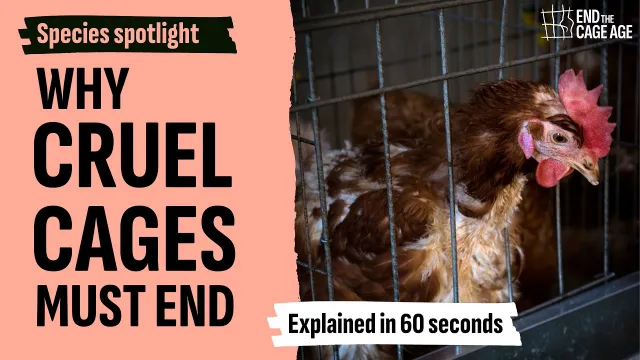 Farming laying hens in cages MUST END, here's whyCompassion in World Farming, 1 min
Short explainer on space per hen in enriched cages in the EU. From an advocacy group.
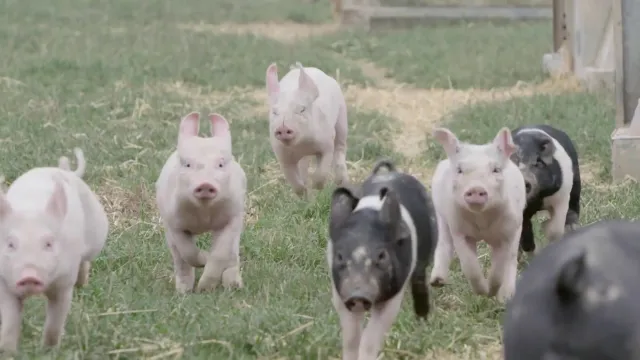 Animals experiencing a life worth livingCompassion in World Farming, 5 min
Footage of farm animals in better systems. From an advocacy group.
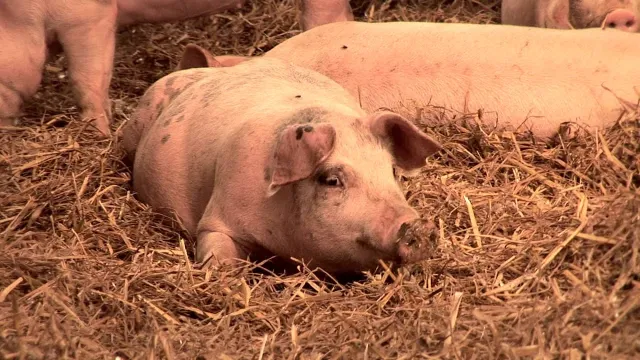 How was this animal kept? (Director's cut)Compassion in World Farming, 8 min
Campaign film for clear farm-system labelling on meat, milk and eggs. From an advocacy group.
Sources
- Council Directive 1999/74/EC, laying hens (EUR-Lex)
- Bord Bia Sustainable Egg Assurance Scheme standard, Rev 04 (PDF)
- Regulation (EU) 2018/848, organic production (EUR-Lex)
- Implementing Regulation (EU) 2020/464, organic rules (EUR-Lex)
- University of Giessen 2024: breastbone damage in laying hens (carried over from the German table, not re-opened for Ireland)
- Everything on Eggs
- How long do laying hens live?
- Do laying hens ever see their mother?
- How much space does a laying hen have?
- How often are laying hens outside?
- Are laying hens' beaks trimmed?
- How long are laying hens transported?
- How are laying hens killed?
- Label: Legal minimum (EU and Irish law)
- Label: Free range (EU marketing rules)
- Label: Bord Bia Quality Assurance
- Label: EU organic (Irish certifying bodies)
- Legal minimum (EU and Irish law) vs Bord Bia Quality Assurance: Eggs
- Legal minimum (EU and Irish law) vs Free range (EU marketing rules): Eggs
- Legal minimum (EU and Irish law) vs EU organic (Irish certifying bodies): Eggs
- Bord Bia Quality Assurance vs Free range (EU marketing rules): Eggs