 How my food lives
Pork · Outdoors
Do pigs go outside?
Usual: a barn without a run, with RAUS (Swiss programme for regular outdoor access) a run every day. Here the standards barely differ: 10 reach level 4.
Why it is like this
The law and BTS (Swiss programme for animal-friendly housing) require no run. More than 52 percent of Swiss pig farms take part in the voluntary programme RAUS, which requires several hours of run every day. Knospe requires a permanently accessible run. Organic pork had a market share of a good 2 percent in the first half of 2022.
What the labels say
| Standard | Level |
|---|---|
| Legal minimum (Animal Welfare Ordinance, TSchV) | 1 Never. A bright barn is enough |
| BTS (Swiss federal programme for especially animal-friendly housing) | 1 Never. A bright barn is enough |
| BTS and RAUS (Swiss federal programmes: animal-friendly housing and regular outdoor access) | 4 On almost every day |
| Organic under the Swiss Organic Farming Ordinance | 4 On almost every day |
| Knospe (Bio Suisse organic label, "the bud") | 4 On almost every day |
| Demeter (Switzerland) | 4 On almost every day |
| KAGfreiland | 4 On almost every day |
| IP-SUISSE (BTS and RAUS) | 4 On almost every day |
| Coop Naturafarm pork | 4 On almost every day |
| Lidl Cura Porc (formerly Terra Natura pigs) | 4 On almost every day |
| Silvestri free-range pig (IP-SUISSE) | 4 On almost every day |
| Silvestri alpine pig (IP-SUISSE and Pro Montagna) | 4 On almost every day |
How we read the levels
- Never. A bright barn is enough.
- Never, but it feels fresh air in the barn.
- On a few days a week.
- On almost every day.
Level 1: Never. A bright barn is enough.
Applies to: Legal minimum (Animal Welfare Ordinance, TSchV) and BTS (Swiss federal programme for especially animal-friendly housing)
The pig never has to go outside. A bright barn is enough; that is the state under the law and under BTS without RAUS.
Neither animal welfare law nor BTS requires an outdoor run for fattening pigs. The run is covered by the federal programme RAUS, which is voluntary. More than 52 percent of Swiss pig farms take part, and 56 percent take part in BTS (Proviande, citing the Agrarbericht 2025).
Level 4: On almost every day.
Applies to: BTS and RAUS (Swiss federal programmes: animal-friendly housing and regular outdoor access), Organic under the Swiss Organic Farming Ordinance, Knospe (Bio Suisse organic label, "the bud"), Demeter (Switzerland), KAGfreiland, IP-SUISSE (BTS and RAUS), Coop Naturafarm pork, Lidl Cura Porc (formerly Terra Natura pigs), Silvestri free-range pig (IP-SUISSE) and Silvestri alpine pig (IP-SUISSE and Pro Montagna)
The pig has a run on almost every day: at RAUS (Swiss programme for regular outdoor access) several hours a day, at Knospe, Demeter, KAGfreiland and Lidl permanently accessible.
RAUS requires several hours of access to a run or pasture every day (Annex 6 part B DZV, fattening pigs over 60 kg at least 0.65 m², under 60 kg 0.45 m²). At Knospe all pigs have daily access to a run from day 24 of life, and fattening pigs a permanently accessible one. Lidl Cura Porc, Silvestri Freilandschwein (outdoors) and Alpschwein (rooting and wallowing area on natural ground) are in the same range. A run usually means a paved yard; pasture is required only for the free-range pigs. About 2 percent of pork sales are organic (first half of 2022, Bio Suisse via Proviande).
What stays open
There is no rule on this that we found.
Videos
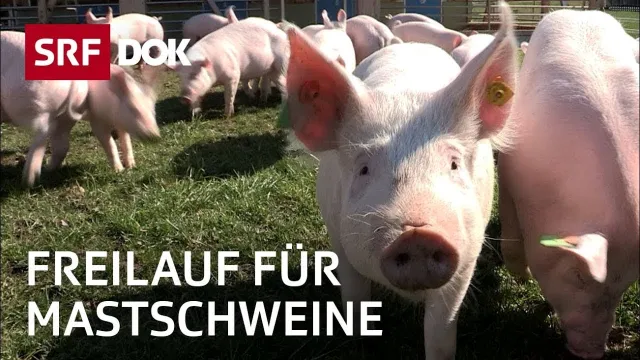 How a pig farmer wants to improve animal keepingSRF Dokus und Reportagen, 24 min
A farmer in canton Lucerne rebuilds a farm with 1,800 animals a year so that every pig can root, bathe and go out on grass.
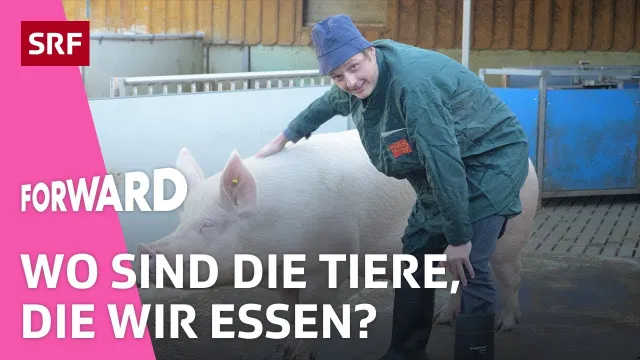 Livestock farming in Switzerland: where are the animals we eat?SRF Impact, 8 min
A reporter who looks after woolly pigs himself asks why we see so little of the pigs, cattle and chickens living in Switzerland.
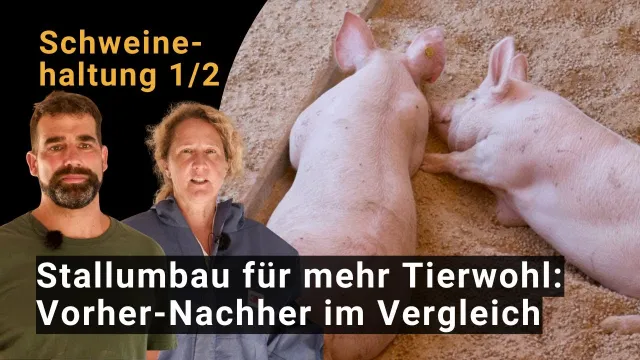 Before and after: rebuilding a barn for fattening pigsFiBL, 6 min
An adviser from the Research Institute of Organic Agriculture shows a conversion with a pool, outdoor run and rooting area.
Sources
- Animal Welfare Ordinance SR 455.1, as of 1 Feb 2026 (seen 21 Nov 2026)
- Direct Payments Ordinance SR 910.13, as of 1 Jan 2026 (seen 21 Nov 2026)
- Proviande: dossier on animal keeping (2022, with figures from the 2025 Agrarbericht, BFS farm census 2020)
- Organic Farming Ordinance SR 910.18 (Fedlex)
- Bio Suisse standards 2026, part II (Knospe)
- Demeter Switzerland standards 2026
- KAGfreiland animal husbandry guidelines 2026
- IP-SUISSE animal husbandry guidelines (as of March 2026)
- Coop Naturafarm basic standards, released December 2020 (archive copy of 3 Jun 2025)
- Lidl Cura Porc pig guideline, valid from 1 Jan 2026
- Silvestri free-range pig guidelines for IP-SUISSE, January 2023 (archive copy)
- Silvestri alpine pig guidelines for IP-SUISSE and Pro Montagna, January 2023 (archive copy)
- Everything on Pork
- How long do fattening pigs live?
- How long do piglets stay with the sow?
- How much space does a fattening pig have?
- What do pigs lie on in the barn?
- Are pigs' tails docked?
- How long are pigs transported?
- How are pigs slaughtered?
- Label: Legal minimum
- Label: BTS and RAUS (federal programmes)
- Label: Organic under the Swiss ordinance
- Label: Knospe (Bio Suisse)
- Label: Demeter
- Label: KAGfreiland
- Label: IP-SUISSE
- Label: Coop Naturafarm
- Label: Lidl Cura Porc
- Label: Silvestri (free-range pig, alpine pig, pasture beef)
- Knospe (Bio Suisse) vs Organic under the Swiss ordinance: Pork
- Knospe (Bio Suisse) vs Demeter: Pork
- BTS and RAUS (federal programmes) vs Organic under the Swiss ordinance: Pork
- Knospe (Bio Suisse) vs IP-SUISSE: Pork